Is There an API for EWC Code Classification?
Yes. WasteCheck's classify-waste endpoint uses AI to map plain-English waste descriptions to the correct European Waste Catalogue codes.
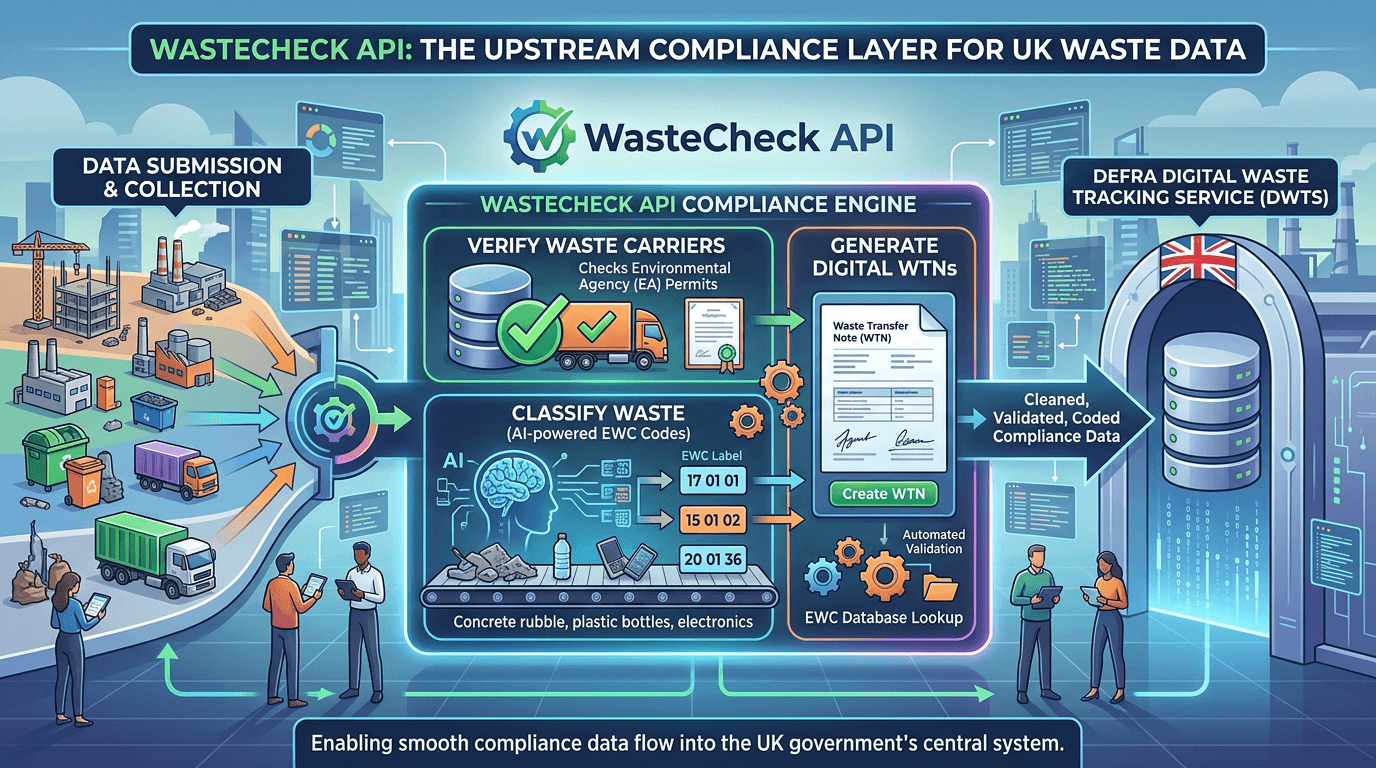
Yes — WasteCheck's /v1/classify-waste endpoint takes a plain-English waste description and returns the correct European Waste Catalogue (EWC) code(s) using AI. Submit a description and optional source industry, and get back up to five EWC codes ranked by confidence score, with hazardous waste flags, consignment note requirements, and the reasoning behind each classification.
Why EWC classification is harder than it looks
The European Waste Catalogue contains roughly 650 six-digit codes across 20 chapters. The correct code isn't just about the material — it depends on the activity that produced the waste. Plasterboard from a construction site falls under chapter 17 (construction and demolition wastes). The same material from a manufacturing process falls under chapter 10 or 12. Contaminated plasterboard might be hazardous, pulling in mirror entry codes where classification depends on concentration thresholds.
Codes marked with an asterisk are classified as hazardous waste. That triggers additional requirements: consignment notes instead of transfer notes, pre-notification to the Environment Agency, and stricter handling and disposal rules. A missed hazardous classification isn't a minor admin error.
Existing tools — WasteSupport, WhatWasteCode, CSG — are keyword search interfaces. None offer an API. None use AI. None account for source industry context.
How the API works
curl -X POST https://api.wastecheck.co.uk/v1/classify-waste \
  -H "Authorization: Bearer wc_live_your_key" \
  -H "Content-Type: application/json" \
  -d '{
    "description": "Broken plasterboard from office refurbishment",
    "source_industry": "construction"
  }'
{
  "classifications": [{
    "ewc_code": "17 08 02",
    "description": "Gypsum-based construction materials",
    "chapter": "17 - Construction and demolition wastes",
    "is_hazardous": false,
    "confidence": 0.94,
    "reasoning": "Plasterboard is gypsum-based. Non-contaminated material from construction falls under chapter 17."
  }],
  "compliance": {
    "hazardous_waste": false,
    "requires_consignment_note": false
  }
}
Confidence scoring
Every classification comes with a score between 0 and 1:
| Score | Interpretation | Recommended action |
|---|---|---|
| 0.9–1.0 | High confidence | Safe to use directly |
| 0.7–0.89 | Moderate confidence | Acceptable, review if waste is unusual |
| Below 0.7 | Low confidence | Manual review recommended — LOW_CONFIDENCE flag returned |
The reasoning field
The reasoning field explains why a code was selected. If a regulator asks why you used 17 08 02, you have a documented rationale rather than "the system picked it." This matters for audit trails and duty of care compliance.

Caching
Classifications are cached for 7 days based on the exact combination of description and source industry. EWC codes don't change, so cached results stay accurate. The metadata.cached field in the response tells you whether the result came from cache.
DEFRA requirement
DEFRA's Receipt of Waste API requires valid EWC codes as a mandatory field for every waste movement record. The codes must be properly formatted six-digit codes, not free-text descriptions. WasteCheck produces exactly this — validated, structured codes ready to submit.

Get started
Sign up at app.wastecheck.co.uk. Full documentation at docs.wastecheck.co.uk.
Try WasteCheck for free
50 API calls per month on the free tier. No credit card required.
Get your API key