What Is a Digital Waste Transfer Note and How Do I Generate One?
A Waste Transfer Note is the legal document required every time controlled waste changes hands. Here's what it must contain and how to generate one via API.
A Waste Transfer Note is the legal document required every time controlled waste changes hands in England and Wales. It records the waste producer, the carrier, the waste description and EWC code, quantity, destination, and date of transfer. Both parties must sign it and keep a copy for at least two years.
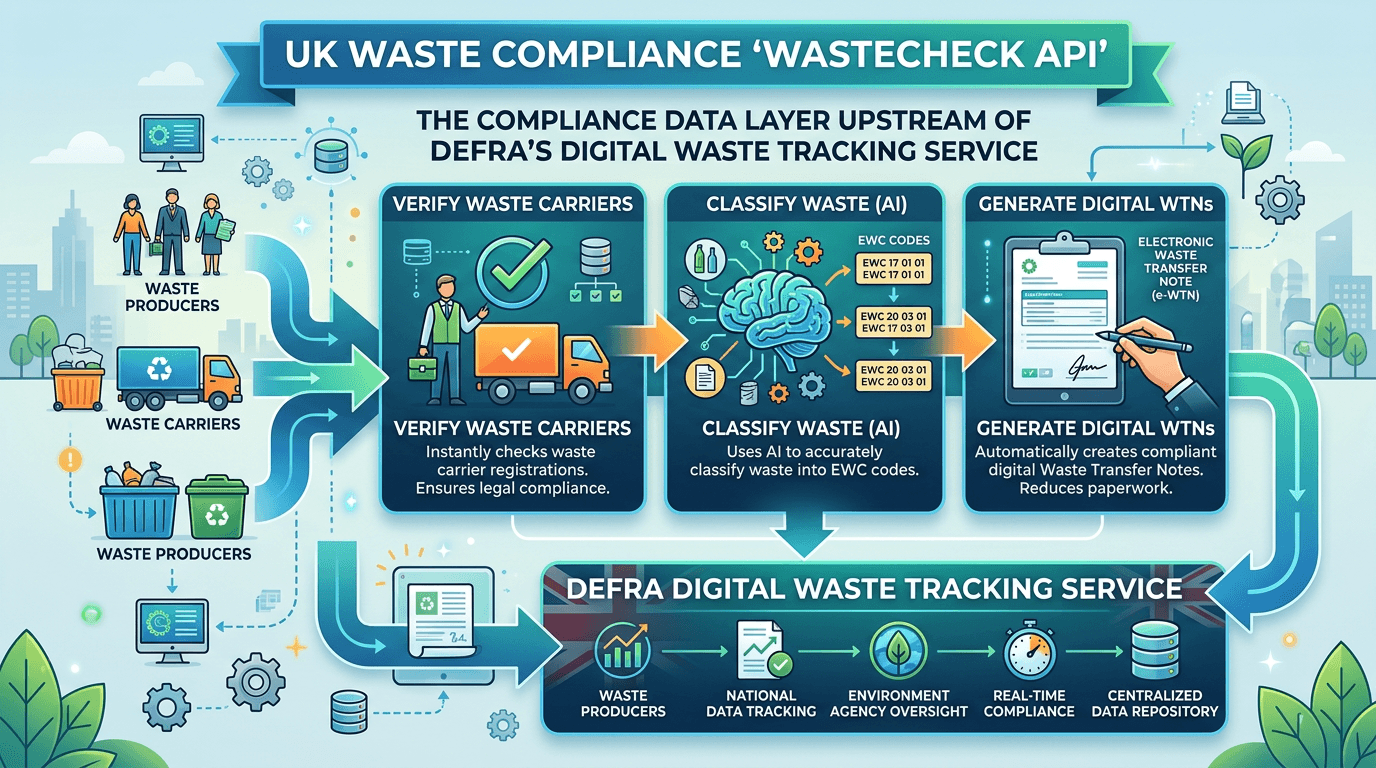
WasteCheck's /v1/generate-wtn endpoint produces a fully structured, compliance-checked digital WTN in a single API call — running carrier verification and waste classification automatically in the background.
What a WTN must legally contain
The duty of care regulations require:
- Producer details — name, address, SIC code
- Carrier details — name, registration number, registration tier
- Waste description — plain-English description and EWC code
- Quantity and container type
- Destination facility — name, address, permit number
- Date of transfer
Missing any of these, or getting them wrong (expired carrier registration, incorrect EWC code), means the WTN doesn't satisfy duty of care requirements.
Generating a WTN via API
curl -X POST https://api.wastecheck.co.uk/v1/generate-wtn \
  -H "Authorization: Bearer wc_live_your_key" \
  -H "Content-Type: application/json" \
  -d '{
    "producer": {
      "name": "ABC Office Fit-out Ltd",
      "address": "45 High Street, Bournemouth, BH1 2AA"
    },
    "carrier": {
      "registration_number": "CBDU217016",
      "auto_verify": true
    },
    "waste": {
      "description": "Broken plasterboard from office refurbishment",
      "auto_classify": true,
      "quantity_kg": 2500,
      "container_type": "skip"
    },
    "destination": {
      "name": "South Coast Recycling Ltd",
      "address": "Industrial Estate, Poole, BH15 1NF",
      "permit_number": "EPR/AB1234CD"
    },
    "transfer_date": "2026-03-25"
  }'
Setting auto_verify: true and auto_classify: true tells the API to run carrier verification and waste classification in parallel internally. You get a complete, compliance-checked document from a single call.
The duty of care checklist
Every WTN response includes a duty_of_care object:
{
  "duty_of_care": {
    "producer_identified": true,
    "carrier_verified": true,
    "waste_classified": true,
    "destination_provided": true,
    "all_checks_passed": true
  }
}
This is what paper WTNs can't give you. A paper form can't tell you the carrier registration expired last month or that the EWC code doesn't match the waste. The API flags both.
Storage and retrieval
Every WTN gets a unique reference (WTN-YYYY-MMDD-XXXX) and is stored for retrieval via GET /v1/wtn/{reference}. You don't need to build your own document storage — the API handles persistence.
Speed
Full WTN generation typically takes 2–3 seconds because carrier verification and classification run in parallel. If you already have the EWC code, set auto_classify: false and provide it directly — that drops latency to around 500ms.
DEFRA context
DEFRA's Digital Waste Tracking mandate makes digital waste records mandatory for waste receiving sites from October 2026, and for waste collectors from October 2027. WasteCheck's WTN output is structured to map directly to the fields DEFRA's Receipt of Waste API requires.
Get started
Free tier at app.wastecheck.co.uk. Full documentation at docs.wastecheck.co.uk.
Try WasteCheck for free
50 API calls per month on the free tier. No credit card required.
Get your API key